Crisis Simulation: Why Most Companies Are Not Prepared | May 08th, 2026 | Intelligence and Risk Management
Edition #65 | Your Week's Final


Good Afternoon,
In today’s business environment, most organizations operate under the assumption that having policies, manuals, and emergency procedures automatically means they are prepared for a crisis. In reality, preparedness is rarely tested until an actual disruption occurs.
Whether the crisis is cyber related, reputational, operational, financial, or legal, the biggest failures often emerge not from the event itself, but from delayed decision making, communication breakdowns, and uncertainty inside leadership teams.
Modern risk management is no longer only about prevention. It is about response capability under pressure.
Regulatory Reporting Athena Accountants + Risk Advisory
Athena Perspective
At Athena, we view crisis simulation as an essential intelligence function. Companies that regularly test scenarios are significantly more capable of protecting operations, maintaining stakeholder confidence, and reducing long term damage during high pressure situations.
A crisis simulation is not designed to predict the future perfectly. Its purpose is to expose weaknesses before a real event does.
Many organizations discover critical vulnerabilities during simulations, including:
Unclear chains of command
Delayed executive approvals
Communication gaps between departments
Lack of media response coordination
Vendor dependencies
Inconsistent cybersecurity procedures
Missing contingency planning
The most resilient organizations treat preparedness as an ongoing operational discipline rather than a one time compliance exercise.
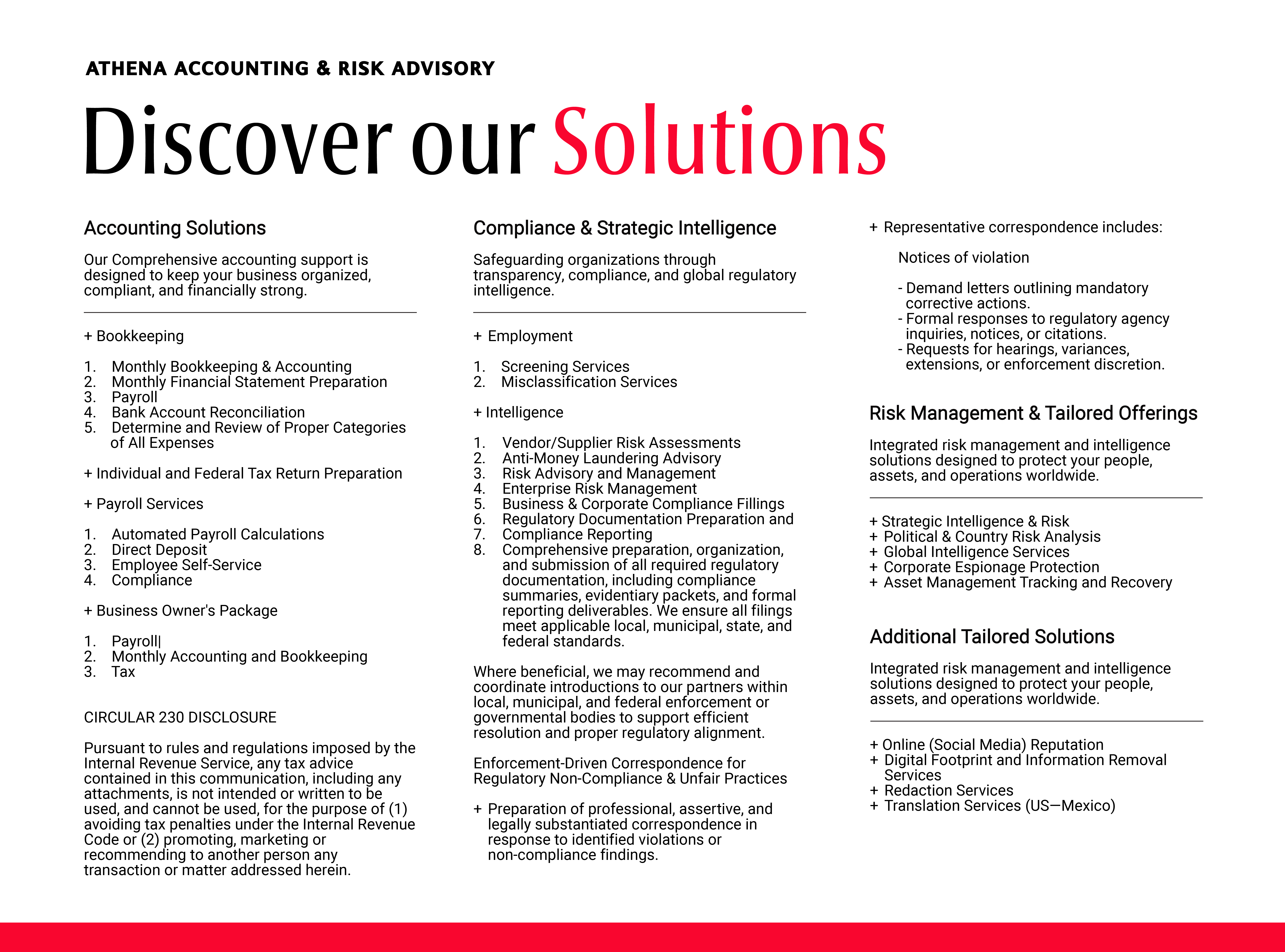
What We Do in the Regulatory Reporting Process
Data Collection
We gather information from many internal areas and systems, such as finance, operations, risk, and compliance, to consolidate all data needed for regulatory reporting.
Validation and Quality Control
We check the data for accuracy, consistency, and completeness to avoid discrepancies.
Transformation and Standardization
We format the data according to regulatory requirements (e.g., XBRL, XML, CSV) and apply necessary calculations.
Report Preparation and Submission
We create and submit reports to regulators on time, following the required frameworks, and track any feedback.
Audit and Record Keeping
We keep clear records of all steps to support audits and ensure ongoing compliance.
Regulatory Monitoring
We stay updated on regulatory changes and adjust our processes to keep organizations aligned with new requirements.
Today’s Workspace
An effective crisis simulation should involve multiple departments simultaneously because real crises rarely remain isolated within one function.
Key participants often include:
Executive leadership
Legal and compliance
Public relations and communications
Finance
Operations
Human resources
Cybersecurity and IT
External advisors when necessary
Common simulation scenarios include:
Cybersecurity Incident: A ransomware attack compromises company systems and customer information. Leadership must decide how to respond publicly, maintain operations, and coordinate legal obligations.
Reputational Crisis: A viral social media accusation begins affecting brand perception and investor confidence. Teams must respond quickly while verifying facts internally.
Operational Disruption: A critical supplier unexpectedly shuts down operations, creating immediate supply chain instability and financial exposure.
Internal Misconduct: An internal whistleblower allegation creates legal, reputational, and governance concerns requiring coordinated executive action.
The value of these exercises is not perfection. The value comes from identifying pressure points before they become real liabilities.

Case Study | CrowdStrike Global Outage
This case is presented solely as an illustration of individual due diligence considerations. All references below are based on publicly reported information and investigative journalism. They reflect allegations and reported facts, not findings of wrongdoing or legal conclusions.
In 2024, a faulty software update connected to cybersecurity systems caused one of the largest global IT disruptions in recent years. Airlines, financial institutions, healthcare systems, and corporations worldwide experienced operational interruptions simultaneously.
The incident demonstrated several important realities:
Even highly sophisticated systems remain vulnerable to cascading failures
Third party dependencies can become enterprise wide risks
Communication speed becomes critical during uncertainty
Organizations with established incident response structures recovered faster
The event also reinforced the importance of scenario testing and operational coordination across multiple departments.
For many companies, the outage became a real world reminder that resilience depends not only on technology, but on preparedness, leadership coordination, and decision making under pressure.

Closing Thought
A company’s true preparedness is revealed during moments of disruption, not during routine operations.
The organizations that navigate crises most effectively are rarely the ones with the largest manuals. They are the ones that have practiced decision making, communication, and coordination before the pressure becomes real.
In modern intelligence and risk management, simulation is no longer optional. It is part of resilience itself.
The Compliance Chuckle: A Tiny Break From Serious Adulting 😅

Your Wellness Section
Decision Fatigue During Crisis Situations
High pressure environments force executives and teams to make rapid decisions with incomplete information. Over time, this creates cognitive fatigue that can affect judgment, communication, and prioritization.
Organizations that implement structured crisis protocols and simulation exercises often reduce unnecessary decision overload because responsibilities and escalation procedures are already clearly defined before an actual emergency occurs.
Preparedness improves not only operational resilience, but also leadership clarity during uncertainty.

Evolving with purpose!
A New Chapter for Athena
We’re growing to serve you better. Athena Risk Management has evolved into Athena Accountants + Risk Advisory, reflecting our expanded focus on integrated accounting, compliance, and risk solutions.
This transition marks more than a name change—it’s a renewed commitment to precision, transparency, and strategic support for your business.
Explore the full site at: aaradvisory.com
Same values. Broader vision. Stronger partnership.
A Small Update
✨ We’ve moved this newsletter to Substack
This transition allows us to share our thinking with more depth, more continuity, and a closer connection to our readers. Substack gives us the space to expand on intelligence, risk, and decision making without rushing conclusions or compressing nuance.
We look forward to continuing to share insights, perspectives, and future editions we hope you’ll find thoughtful, relevant, and worth returning to.
Explore all of our newsletter editions here: @aaradvisory
In Case You Missed It…
Check Out Our Other Newsletters!
In addition to our AARA updates, we invite you to explore insights and analysis from our other newsletters:
▶ GCAM-9ED
Market positioning, earnings on deck, sector momentum, and directional signals, plus key shifts, catalysts, corporate moves, and sector psychology.
greycatalystam.com | contact@greycatalystam.com | + 1 415 930-9460
▶ León Barrena Rodríguez & Partners LLP
Explore here for perspectives on Mexico/US governmental affairs, curated by our global team and Mexico City office.
lbr-global.com | contact@lbr-global.com | + 1 202 410-4006
Learn more about current projects, industry trends, and expert insights from our construction solutions team.
degroupusa.com | hello@degroupusa.com | +1 925 940-7099
▶ National Nurseries & Vintage + Antique Tiles:
Stay updated on weather effects, safety protocols, and daily compliance updates from our construction specialists.
bynationals.com | hello@bynationals.com | +1 925 456-4980
Discover resources designed to help you stay ahead, navigate challenges, and make informed decisions.
From Our Team
Secure Strategic Operations with GCAM-9ED's Athena Accountants + Risk Advisory

At GCAM-9ED, we believe smart growth depends on more than capital, it requires risk intelligence, operational security, and real-world preparedness. That’s why we built Athena Accounting + Risk Advisory, our in-house division specializing in physical security, geopolitical risk, and executive protection.
From travel intelligence and crisis response to embedded risk officers and threat monitoring, Athena equips clients with the tools to operate confidently in volatile environments. Whether you're entering new markets, protecting key personnel, or managing high-risk assets, Athena delivers tailored solutions that align security with strategy.
Resilience is a competitive edge. Let's build it into your operations.
Contact us at hello@aaradvisory.com
Discover Athena Accountants + Risk Advisory
X | Instagram | Contact us
DISCLAIMER: This newsletter is for informational purposes only. The content reflects a summary of publicly available information and does not represent legal, financial, or political advice. Athena Accountants + Risk Advisory is not responsible for decisions made based on this material.
Share Athena Accountants + Risk Advisory Newsletter
Enjoying our newsletter? Share it with colleagues, LPs, family offices, operators, or anyone who needs to stay sharp on market trends, government policy, and multifamily office strategy.
You currently have 0 referrals — just 5 away from unlocking exclusive access to a behind-the-scenes strategy call with the Athena Accountants + Risk Advisory team.
